QUEST BREAKDOWN:
Year 2 main story intro
Overview
design intent
Project: Skull & Bones
Quest Name: Risk of Ruin (Year 2 Main Story Introduction)
Role: Quest/Level Designer, sole ownership on quest flow, pacing, and in-engine implementation.
Team: 1 Quest/Level Designer, 1 Narrative Designer, 2 Writers, 3 Cinematic Designers
Duration: ~8 weeks
This quest serves as the first main story quest of Year 2, acting as a narrative and mechanical on-ramp for new content. From a quest design perspective, the primary focus was on establishing strong pacing, and re-anchoring players in existing characters while setting expectations for the year ahead.
Additionally, I had a personal goal for this quest - shifting how main story quests are initiated and paced. Instead of relying on a traditional NPC hand-off, I wanted players to feel like they stumbled into the quest themselves, driven by curiosity and opportunity rather than instruction.
🏆Outcome: This quest received a lot of praise from players saying how much they enjoyed it and would like to see more of this kind of quests moving forward
constraints
Time was the primary constraint.
The request for a Main Story Quest came almost midway through development of the upcoming season. The original plan was not to include a main story quest due to resourcing constraints, which meant this feature had to be scoped, designed, and delivered within an already active production schedule.
Because of this, I needed to be deliberate about:
Defining a clear, achievable narrative and gameplay scope
Reusing existing systems and locations where appropriate
Focusing effort on moments that would have the biggest impact on pacing and player experience
This constraint heavily influenced my design decisions, pushing me to prioritize clarity, flow, and execution quality over breadth or feature complexity.
Design Process
Understanding the Narrative
As development on this quest began later than planned, I worked closely with the narrative team to understand the broader direction of the story and how this quest needed to contribute to future seasons.
At that point, the only confirmed narrative requirement was to seed the existence of a mysterious arms dealer supplying exotic weapons across the Indian Ocean, with the intent that their identity would be revealed in a subsequent season.
Without a fully defined arc to work from, I focused on shaping a quest structure that could land this narrative beat effectively, while still feeling complete and satisfying on its own.
Breaking down the Narrative Beat
Narrative beat:
Establish the presence of a shadowy arms dealer supplying weapons across the region.
Problem Space:
How do we introduce an unseen antagonist in a way that feels organic and intriguing, rather than expositional?
Design Approach:
Instead of directly introducing the arms dealer, I reversed the narrative logic of the beat:
Weapons > Supply Chain > Hidden Supplier
This allowed the story to unfold through player action rather than explicit explanation.
Creating the Hook
The quest begins as a familiar setup for the player:
a pursuit of a weapons convoy believed to be carrying valuable loot.
As the quest progresses, what initially feels like a routine objective gradually reveals a deeper mystery — the scale, coordination, and quality of the weapons point to a supplier operating far beyond what the player has encountered before.
This shift reframes the player’s goal from acquiring treasure to uncovering the source, naturally setting up the arms dealer as a looming presence without revealing them directly.
Establishing Core Goals
Before designing quest beats, I started with the core goals and player experience this quest needed to deliver:
Allow players to initiate the quest organically
Start with a clear, simple motivation (chasing treasure)
Gradually reveal a deeper narrative mystery
Use pacing and cutscenes to reinforce world state without halting momentum
Rather than front-loading information, my goal was to let the story unfold through action, allowing players to absorb context naturally as they progressed.
Broad Strokes
With the design intent clearly defined, I mapped the quest at a high level, focusing on rhythm and emotional pacing rather than individual objectives or mechanics.
At this stage, the goal was to ensure the quest had a clear narrative and gameplay arc before moving into detailed implementation.
The quest was structured around a few key beats:
An organic starting point, allowing players to feel like they initiated the quest themselves rather than being directed by an NPC
Re-establishing key legacy characters through cutscenes that also communicated the evolving state of the world
A climactic boss encounter that serves as a payoff for the build-up
A closing interaction with a familiar antagonist from a previous season, reframing the events of the quest and deepening the mystery around the true supplier of the weapons
By defining these beats early, I was able to reason about pacing, narrative flow, and player motivation before committing to specific objectives or encounter design.
Highlight
Mid-Quest Revelation
One of the key moments in the quest was the convergence at the outpost, where multiple narrative threads intersected naturally through gameplay.
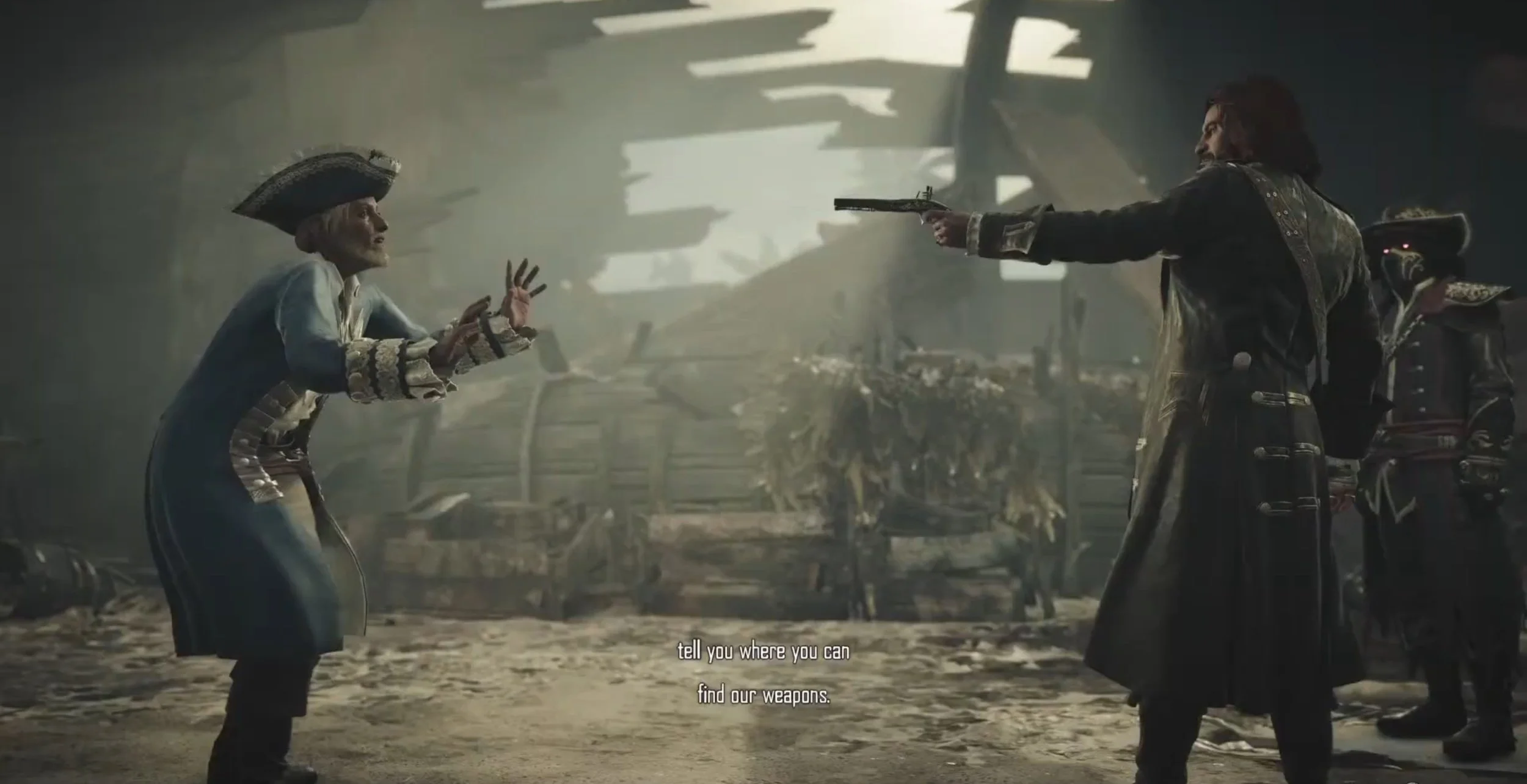
As players chased the convoy to its destination, they discovered that several ships from the Kingpin’s fleet were also attacking the same target. This was intentionally left unexplained at first, creating a moment of uncertainty and tension. Players were meant to ask why the Kingpin’s forces were operating in the area and what their interest in the convoy was.
After the convoy was sunk, the quest flow slowed down deliberately. Players searched the outpost for clues related to the weapons shipment, allowing anticipation to build before revealing the answer. This investigation phase served as a breather after the naval combat while reinforcing the mystery.
The payoff came through a surprise cutscene, where it was revealed that the Kingpin himself had been pursuing the convoy, attempting to secure the weapons for his own ends. The scene escalated further with the appearance of a familiar antagonist, reframing the entire encounter and establishing that multiple powerful forces were now competing for control over these weapons.
This sequence was designed to:
Create intrigue through temporary player confusion
Use pacing to separate action, investigation, and revelation
Reinforce the idea that the player is operating within a larger, contested world, rather than being the sole actor driving events
learnings & takeaways
Player-driven quest initiation increases engagement
Allowing players to feel like they stumbled into the quest — rather than being explicitly sent by an NPC — created a stronger sense of agency.
Familiar actions are effective entry points for deeper narrative beats
Using a routine gameplay hook made the eventual reveal of a larger mystery (the arms dealer and competing interests) more impactful. Players were already invested before the stakes escalated.
Mid-quest narrative beats can improve pacing when used sparingly
Placing a surprise cutscene in the middle of the quest — rather than saving all narrative payoff for the end — helped maintain momentum and recontextualize the player’s actions. This broke up extended gameplay segments and kept the experience feeling dynamic.
Scoping early is critical when narrative development starts late
With time as the primary constraint, focusing on high-impact beats — rather than additional objectives or mechanics — ensured the quest still delivered narrative weight and strong pacing without compromising quality.